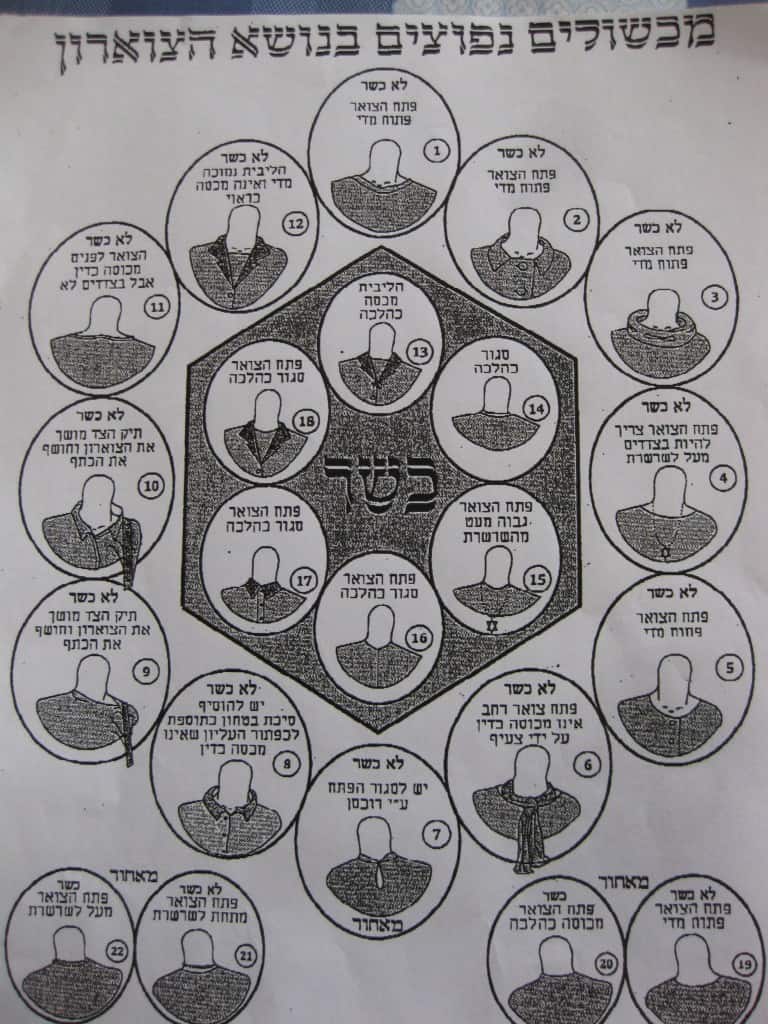
Haredi Guidelines for Neckline Tzniut
This document is entitled: “Common Pitfalls Regarding Necklines.” At the bottom (cut off) it reads: These pages have been viewed by Rabbi Nissim Karelitz Shlit”a and Rabbi Moshe Shaul Klein Shlit”a from the rabbinic court of Rabbi Vozner Shlit”a.*
You can see common Israeli neckline styles here. The rabbis who signed off on the above document hold by stringencies not observed by all camps in the Orthodox community. Rabbis from the national religious community are more lenient about how much to expose, but none would permit a plunging necking or decolletage.
Of the 22 pictures, the first twelve are labelled “Not Kosher”:
1-3, 5: The neckhole is too open.
4: The neckhole needs to be above the necklace at the sides. [To judge the neckline, a woman wears a chain around her neck. The back and sides of the collar or outfit must cover her skin to the point just above where the chain lies on her neck. As pictured, a boat neckline exposes too much.]
6: The wide neckhole is not covered by the scarf, according to Jewish law.
7: From the back. The opening must be closed with a zipper.
8: A safety pin should be added to the top button, which does not cover according to law.
9-10: The shoulder bag pulls the collar and exposes the shoulder.
11: The neck is covered in front according to law, but not the sides.
12: The dickey (libit) is too low and does not cover properly.
Thirteen through eighteen, inside the central hexagon, are kosher:
13: The dickey (libit) covers according to Jewish law.
14: Closed according to Jewish law.
15: The neck opening is slightly higher than the chain.
16-18: The neckline is closed according to Jewish law.
Nineteen through twenty-two are pictures of views from the back (hard to tell when there are no faces visible).
19: Not kosher, the neckhole is too open.
20: Kosher, the neckhole covers according to Jewish law.
21: Not kosher, the neckhole is under the chain.
22: Kosher, the neckhole is above the chain.
Please keep comments respectful.
*Shlit”a: An acronym meaning “May he live a good and long life.”
Update: G6 left the following comment:
The document you posted is certainly the strictest stance and many very frum, yeshivish, right wing rabbonim would NOT agree that all these stringencies are required.
I would suggest that everyone consult their own posek (rabbinic authority) instead of imposing (possibly unnecessary) restrictions upon themselves based on an internet posting.
G6, there are people who are looking for more stringencies, but this is not the strictest opinion. I have seen sources quoted for covering the neck entirely.
I don’t know–they could have been worried about what you would say.
Wow – I tried to wear something like 1 and 11 to my relatives in Tel Arza (they’ve recently moved) in Jerusalem when I lived there and they let me, but they had a couple of relatives who wouldn’t have me over for meals. Maybe this is why?!
Fascinating. Well, to me. Thanks for posting this.
This is so complicated. Why not have fitted regularly undershirts (with back zipper?) so you always know you are in line. This seems so complicated having to deal with this every time you get dressed.
It is interesting that these rabbis felt the need to be so specific about these laws and felt the need to create this document. What faction of Jews do these rabbis “rule” over?
The document you posted is certainly the strictest stance and many very frum, yeshivish, right wing rabbonim would NOT agree that all these stringencies are required.
I would suggest that everyone consult their own posek instead of imposing (possibly unnecessary) restrictions upon themselves based on an internet posting.
I am not even Jewish and I find this document very interesting. I can imagine some very lovely garments that would meet the restrictions presented here. Perhaps a little more modesty would not be amiss in the world.
Then again, I must confess to worrying more about cleavage than collar bone.
Thank you for posting the document!
G6, good point and I added your comment to the post. But as I wrote there, this is not the most stringent opinion. Some advocate covering the neck entirely.
Mia, there are stores where pre-approved clothes are easily available.
Frayda,I believe all of the rabbis listed are Lithuanian, non-Chasidic rabbis and represent a large percentage of haredi Jewry. (Haredi means ultra-Orthodox, for lack of a better term.) I hope another commenter can be more specific.
Kim, thanks for visiting. Many people are unhappy with the difficulty of finding modest clothing.
Tesyaa, I think I know who you are now.
Frayda, many volumes have been written about minutiae of Jewish law. But regarding modesty, the haredi rabbinate has a problem as large numbers of girls and women in their community who are not following the letter of the law, or maybe not even that. So they need to keep adding specific details so there won’t be any loopholes, so to speak.
Hi Tessya
I have been looking in vain for Startdust bassis shirts. I have a clothing store in Modiin. I have alot of tunics and I want to give my customers the option of dressing in a tznius fashion. Do you kinow where I can find these wholesale or cheaply
Ktiva vechatima Tova
Ronit
I did know a lady who wore turtlenecks almost all the time (I’m trying to remember if I ever saw her differently). She was quite frum, but I never knew if she was dressed that way for tznius reasons. I remember wondering if she had some kind of scar or disfigurement on her neck.
I’m not jewish and I find this stuff fascinating. I think a lot of women regardless of religion find finding semi modest clothes difficult (in secular type stores that is). When I got pregnant and had suddenly larger “assets” shall we say, suddenly none of the clothes I could buy were terribly modest at all – I had to wear vests underneath them so as not to be shocking the general public!
Oy. I work with charedim and they must be totally offended by my clothing. At least in the winter my sleeves tend to be longer.
Probably 90% of the time I am in conformity with that poster, although I am not anywhere near charedi. I have to be honest though, if my Rabbi published something like that and had it posted in the ladies room of the shul, I think I would be really tempted to violate the directions just for the heck of it. I find that kind of top down control over minutiae to be stifling. I guess that’s why I’m “not anywhere near charedi.”
This Shabbat, in my dati leumi community, I saw a bumper sticker on a car which read: Banot Tnzuout Monoat Asonot (Modest Girls Prevent Disasters).
The problem of course is that this implies that non-modestly dressed girls/women cause disasters.
While following the dictates of modest dress is commendable as well as mandated by halacha, blaming less-than-the-strictest for causing disaster is not an acceptable approach, IMHO.
Katherine, even finding clothes for small girls these days is hard.
Baila, no one has said anything right? Do the haredi women you work with follow the posted guidelines?
Fern, I don’t think this kind of thing helps change the people who are really dressing immodestly in that community.
RA, it’s always the women’s fault.
i was just wondering – would the scarf be ok, if the neckhole was properly covered? (they seem to show “correction” for necklaces but not for the scarf one, so i was wondering if scarves are a problem too?
thanks!
great post! this is really interesting and answers a lot of questions for me!
I find it most disturbing that the women in the pictures have stumpy little pinheads.
I agree with what they say at my daughter’s school. Too much talk about modesty isn’t modest. Especially by men.
If modesty is really about women not wanting to show ourselves off, then women should be talking about it, not men. That is, it might be helpful to women to get a clue from men on how the male mind works, but it should be left to women.
Well, I know a guy who has a facebook page about ‘jewish modesty’ that he himself moderates. I talked to his wife and it seems men are more fixated on it than the women b/c men, esp. religious men are more ‘lured’ by a woman’s lack of modesty and even the most innocent mistakes are noticable by them. To look at the facebook page it would seem his idea of modesty borders on muslim interpretation since he posts many referances to the ‘taliban mothers’ and seems to praise them.
Shorty, I’m pretty sure that the answer is yes.
Shoshana, um, yes.
SP613, yes, but in Orthodox Judaism, the (male) rabbis are the arbiters.
Alice, no. I do dress according to Orthodox Jewish standards, but I do not follow the modesty standards of the rabbis who approved this particular document. Orthodox Judaism is not monolithic.
Actually das Yehudis is supposed to be mandated by Jewish women and not the men. I was warned against reading the book Oz vHadar Levusha by Rav Falk, because his writing is misleading. The das Yehudis of Gateshead is not the halacha for the rest of the world.
Is this how you dress? If you don’t mind me asking, that is. I don’t think there is anything wrong with dressing modestly, by the way. It doesn’t offend me that people are particular about it.
MiI — it’s bad enough that the men are the arbiters. But this obsession (of these men) with the tiny details of women’s dress — what can I say, it seems weird. Why are they *so* interested?
My feeling is that they are trying to stop a moving train. I heard about a haredi wedding, where the groom’s family was so upset at the bride’s dress (too wide neckline) that they almost called off the wedding. Too many charedi women/girls are ignoring even the basic standards, and this document is a way of trying to rein things in. And of course you will always have a group of women who like specific guidelines.
Mominisrael, I believe you’re right about trying to stop the moving train — but I believe that the moving train here is connected much more with individual autonomy than with mere modesty. It seems to me that modesty is only the vehicle that these rabbis are using in order to try to keep control of their communities — or at least of the women in them.
Years ago, when I was the guest of a well-known teacher in the local Haredi world, I saw a booklet detailing various modesty “pitfalls” that are very similar to the ones in the above illustration. The booklet urged Jewish women to dress more modestly because there had been so many bus bombings in the recent past. It said explicitly that if women took it upon themselves to dress more modestly, they would prevent similar disasters from occurring in the future. It even offered a free alterations service to make existing clothing more modest.
When my hostess saw me looking at the booklet, she said, “Don’t look at that — it’ll drive you crazy.” To this day I wish I had had the courage to ask her — respectfully, of course — why, if that was her opinion of the booklet, she had it in her home.
Rahel, yes, but the lack of modesty –at least by haredi standards–reflects badly on their authority because it is so obvious. If, say, people stopped following strict kashrut guidelines it would be less blatant. And as anyone with teens knows, it’s hard to control what they wear–but the issue exists among married women as well. I know someone who works for a major Israeli company, and often meets with female representatives of haredi PR firms. He reports that they do not dress according to this document.
I am also curious as to your hostess’s feelings about it.
Ayala, I don’t know how it was handled, as I heard the story second-hand. I’ll try to find out.
“Frankly, all the restrictions in the haredi world remind me of Saudi Arabia, and encourage me to be less externally observant, not more.”
Yes, I also sometimes feel like buying a skimpy bathing suit to spite them, but I prefer not to be influenced by them in either direction.
Regarding the moving train – had the haredi family of the chattan not heard about the mitzvot to make a bride happy on her wedding day, to not publically embarass people and so on?
Frankly, all the restrictions in the haredi world remind me of Saudi Arabia, and encourage me to be less externally observant, not more. I think that people should spend less time being critical of each others appearance and more time looking at the heart of a person and encouraging ahavat Israel and unity.
Why not just go the whole hog and wear a Burka?
Thanks, Stuart, for your comment. Some Jewish women have done that. Just check out the “hyper-tzniut” category on the sidebar.
Comments here are very interesting. I asked a RW Litvishe posek about this “necklace” thing. It is NOT halacha, it’s a suggestion. He said as follows: the neck is vertical, it may be exposed. The shoulder is horizontal. It must be covered. On each individual there is more or less sloping area between the neck and shoulder, of which the majority (>50%) should be covered.
However,I am extremely curious how RZ poskim rule (if they do issue guidelines) as I’ve seen RZ,DL or whatever they might identify themselves as, who, I am sure, take their religious observance seriously, but don’t seem to be covering the collarbones. What, if any, guidelines are there, do you konw?
Sarah, thanks for visiting and commenting. Rabbi Yuval Cherlow, head of the Hesder Yeshiva in Petach Tikva writes in his book, Reshut Hayechid, that the neckline should be closed but not to the point of choking. In general he prefers not to give very specific guidelines.
Wow, I liked all the comments here. Sof b’sof I find myself dressing as my conscience dictates, and always check in the mirror as to how I might appear to others, as a reflection of who I feel I am. IOW if my sleeve is too short FOR ME then even if it looks good in the mirror, I move around alittle to see if I really feel comfortable with it. If not, then I am not dressing the way I feel inside. I prefer that my outside reflect my inside. Some women need to look in the mirror before leaving the home, some just don’t realize how they appear to others. I believe the mystique is in hiding what is most alluring, it calms the mind.
I am just reading this post now in the heat of summer and I actually think it’s nice that someone drew up the guidelines for their community. This is the time when many of us are trying to wear as few layers as possible, and it can’t hurt to know some rules of thumb. For someone who really does want to dress according to the rules of their community (or wants to sit on a bench with more modest dressers) it’s nice to have some guidance. Halacha (Jewish law) is not about deciding for yourself how you feel comfortable (would I be embarrassed to wear this out?). For most who observe Jewish law it is ultimately about trying to do what G-d wants of us. For many it is also about fitting in in our community. It is unfortunate that dressing “too tznius” often can exclude one from social circles. But if a group is truly striving to better themselves according to the guidelines of their circles, why should they have to struggle with decisions in front of the mirror? I have shirts that I bought thinking they were good, then I might decide are not appropriate (maybe the neck is a little wide on the sides, or it’s only tznius when I’m not holding a baby, wearing a purse, or bending over) and then I change my mind a year later. Some might say that this poster would lead women to judge each other to a very strict standard, but I disagree. I think it does the opposite because we don’t need to pay attention to the fashion of others to decide what is right for ourselves. If you never see pictures, all you have to go on are other people you see around, which could lead you to think judgmental thoughts (is it okay the way she’s wearing the necklaces to cover her wide neckline?). This poster actually covers things I wasn’t sure about before – scarves to fill open necklines, boat necks, and gaps where something buttons in the back.
On the ultra-tznius issue: I learned that it would go against Torah to dress like that. (Personally I’m against anything things that divide us, so I have more of a problem with shawl-wearers pulling their kids out of schools with more moderate dressers than I do with the actual dress that they are choosing.) I think there are several issues that make tznius harder than throwing on a tent. We are princesses of Hashem (G-d) and we should strive to dress in a way that is always a good reflection on the chosen people, even if that means people can see we are women and not boxes. For many (often me) covering up doesn’t bother them, it’s putting effort into looking nice that is harder, but it is important. I heard Manis Friedman (A Chabad/Lubuvitch Rabbi who lectures, writes, and runs a seminary for young women) speak to a group of high schoolers about issues with which the group needed some guidance. One thing he brought up is that modest skirts cause us to sit like ladies, and hopefully act like ladies. The very long pleated skirts that were part of the school dress code did not have the same effect, as they still covered the legs no matter what unladylike way the girls sat, stood, or rolled around.
It is a lovely idea that we should not worry about what people think of how we look, but that will never be a reality. When we look for friends or matches for our children, we cannot read minds, and all we have to go on are the outward signs we can see. I’m happy to be friends with anyone who doesn’t smoke and speaks my language. However, when it comes to eating at someone’s house, encouraging my kids to play with their kids, and building lasting friendships, I have to start with the outward signs that tell me if we have things in common. When I cover more of my hair or wear a sheitel (wig), it’s a signal to other women in my religious circle that they can eat at my house and trust me not to corrupt their children. There is nothing uniquely Jewish in the idea that clothing signals the social circles to which we belong. The novelty is that this group published the rules of their “club”.
Yosefa, thank you for sharing that perspective. You make interesting points, especially about tzniut being easy or hard depending on your perspective.
And Simone, thank you for visiting and sharing as well.
Really… This is sad and depressing. I’m a religious woman and think that too much time is spent on worry about necklines by the charedi community and not enough on being a light to the world and loving their fellow Jews of all affiliations.
I wish the men would wear burkas. I hate long beards. Anyways, I felt like I needed to add that a burka is a hood that covers the face entirely, while a hijab is what most non-“charaidi” muslim women wear who cover their hair–the hijab leaves the face uncovered.
I feel bad for the women who feel that they must uphold the millimeters of tzniut in this document. Oy. Now when the rabbaim are done with this shtoot, maybe they can tackle real problems like how to help agunahs.
with you on that simone…
Actually, some Breslaver men covered their faces with cloth on their way to Uman, so they could avoid being tempted on the flight etc.
I know this document. It was also given to me several years ago while I was walking down Shmuel Hanavi in Jerusalem. People give out flyer like this all the time about different laws. The most important thing is to have a rabbi to consult anytime an issue comes up or when something like this bothers you. I kept it but didn’t understand it. Its more of a request but these things are never inforced. Consulting your rabbi could put your mind at rest and that this may not apply to you.
Geefers, that is interesting that it got passed out on the street. Obviously people are concerned about the way women are dressed..
I just want to say that you have to be very careful with a document like this. There are elements in the haredi world that are obsessed with tznius, and they go it extreme lengths, including forging the signatures of great Rabannim. If I saw this on a bus stop, I would immediately assume that the signatures are fraudulent. I would still take it to heart though. Some of the examples are true by anyone’s standards.
Naomi, thanks for visiting. There’s no question of forgery here since it wasn’t actually signed, as I mentioned. Shabbat shalom!
Yes, but they can just used their names without their permission. That’s what I mean by forgery. Rav Chaim Kanievsky has already announced that no one should ever believe that any “kol koreh” issued in his name came from him.
One fact that must be stated is that the most of the halachot, and their derivatives, for tzniut in dress were written to apply to men.
Women’s dress laws are “dat Yehudit”, something that Jewish women over the ages took upon themselves. It is not “dat Moshe”, something that the Torah itself required. While dat Yehudit must be respected, because it is Jewish *womens’* law, it is not on the same level as dat Moshe. There are many things that are dat Yehudit and have now become incorporated, by the Gemara and poskim, into halacha l’maaseh (shiva neki’im is a good example, so is dam leida). However, it remains at the level of “d’rabbanan”, from our Sages, and not “d’oraita”, from the Torah itself.
The first(!) commentator that talks about these requirements specifically for women (excepting the hair-covering issue, which is the ONLY tznius halacha for women that is explicitly required in Torah law) is Tosfos Yom Tov; he takes the standpoint that it is all relative, and not at all absolute. Baalei Tosfos also state that it is all relative. Machatzis Hashekel disagrees; he says that there are absolute rules, that hold for every generation. It is worth noting that he was at the beginning of the war against Reform, and therefore his rulings reflect that. The first one to enumerate these rules was the Malbim, who was not a practicing posek.
Thus, if most people in Jerusalem do not wear socks, one is not required to wear socks. Jerusalem today does not require sock-wearing. If you would take a poll of all Jewish residents of Jerusalem, the vast majority would say that they do not require it. It does not matter what their source is; it matters what the custom of the place is. (FYI, I wear knee socks in all places. I also keep myself tznius according to the “authorities” of the chareidi community, with the exception that I do not dress all in black.)
It is also worth stating that the hair in front of the ears is never required to be covered, “because women never took it upon themselves to cover it” (Shu”t Chatam Sofer, I can look it up). Hair covering in general, as I stated previously, is the only part of womens’ dress that is somewhat mandated d’oraita (kesubos 32:1).
It is also worth mentioning that most of the issue of whether or not a woman has to dress in a tznius fashion is dependent on whether or not a man is allowed to say kriat shema with a woman in front of him dressed in “X” way. Since this is a b’diavad issue (whether or not *he* can do it if he must), we can’t learn out a l’chatchila from it. (Machatzis Hashekel did, and so did Malbim, see comments above. Other poskim did not, presumably because if you learn the siman that way, the entire siman does not make any sense whatsoever.)
Anyone who would like specific sources can ask.
FTR, I do not consider Rav Falk’s book to be authoritative. I have looked at his list of sources, and found many flaws in how he understood them. I have also spoken to several poskim about the book, and they, too, pointed out flaws and told me that his book was not authoritative.